https://www.instagram.com/reel/DJDgRTPzkpY/?igsh=MThxaXp5OHIwbGN4eA==
https://www.instagram.com/reel/DJDfdqhzISB/?igsh=cmZzb2pvbWxkd3Jl
Sent from my iPhone


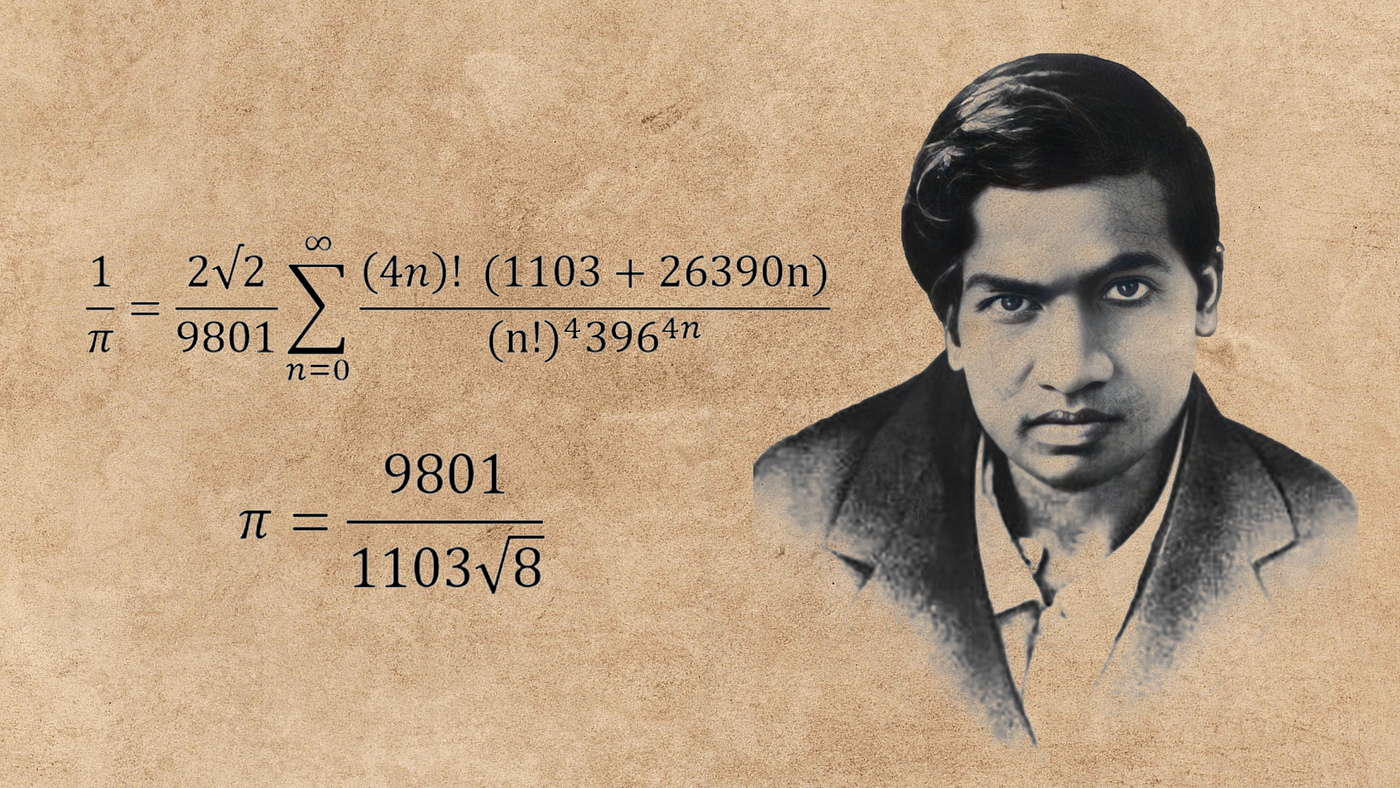
Ramanujan's Magnificent Formula for Pi: 9801/(1103√8)=π
A brief history of nature's most important mathematical constant
π is a mathematical constant that has fascinated and obsessed mathematicians for millennia. Its value is 3.14159. Pi is based on the circumference of a circle, which can be measured by the length of its radius. It was first discovered in Egypt around 3000 BC, but it wasn't a mathematical constant until Archimedes (287–212 BC) derived it. The value of π is a constant so it does not change with time, but pi is useful in many areas of mathematics, science, and engineering.
The history of π goes back thousands of years and has many different names throughout history. It was first used by a mathematics teacher named William Jones a year before Leonhard Euler was born. π has been used to calculate areas, volumes, volumes/spaces, and even lengths in an infinite number of ways. It also plays an important role in fields outside of mathematics such as astronomy and cosmology. It has been used to measure distances between galaxies. It also appears in physics as it relates to electromagnetic waves and many other important concepts.
π was first calculated by Archimedes, who came up with π = 3.14159265358979… This was later improved upon by other mathematicians and scientists such as Archimedes, Eudoxus, Eratosthenes, and Ptolemy.
Ramanujan, a son of a common clerk from India is responsible for some of the greatest contributions in the field of Mathematics. He is considered to be a true genius and a spectacular talent by the majority of Mathematicians. Among many of his gifts to Mathematics, one would be undeniably his formula for π.
His intellect made people regard him as a person of mathematical genius in his local area. He was slowly gaining popularity, outside of his close circle of friends, family, and community. This is why his friends encouraged him to write to the mathematicians from Cambridge. But the irony was, in the heat of the moment, Ramanujan sent several of those letters to the Mathematicians, some with a long list of formulas and no proof at all. The Mathematicians at Cambridge were not new to the idea of letters from cranky enthusiasts with outlandish claims. His letters went unnoticed at first, until, G.H. Hardy recognized the talent behind those words.
Among those letters, many were just revisions of old formulas while few were new and the most crucial ones. Hardy arranged a scholarship for Ramanujan so he could come to Cambridge to study. Here, Ramanujan had a clearer mindset and the best resources to work on his theorems and formulas.
Before understanding Ramanujan's formula for π, let's look at one of the formulas from classical Mathematics. This formula originated from Gottfried Wilhelm Leibniz, a 17th-century Mathematician, who came up with sum which goes like this:

This is an infinite sum. A question may arise. Does this infinite sum have a value? It is intriguing to know that it does have a value which is
In theory, we could use this formula to calculate the value of π. Now Ramanujan, fascinated by this decision to come up with his own formula for π. His formula for pi was,
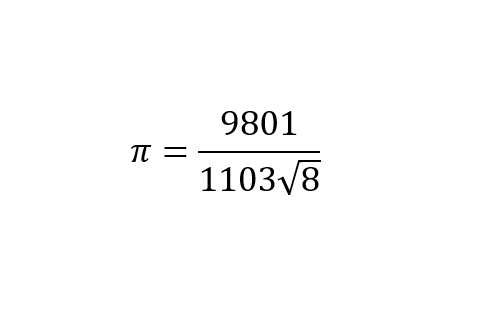
You get the above formula when you put n=0 in the following series that he formulated around 1910 whose value is equal to 1/π.

This gives the accurate value of π up to 6 decimal places, but this is only the 1st term in another infinite series. This number alone is sufficient to calculate the circumference of the Earth with a maximum error of just 1 meter.
It is to be noted that while Ramanujan's formula takes one formula to calculate up to 6 decimal places, it takes Leibniz about 5 million terms. Ramanujan's formula could do it in one term though and each successive term adds up another 8 decimal places to the value of π.
This formula holds absolutely true for finding the value of π, but there is no clear understanding of how he came up with the numbers in his formula like 9801 and 1103.
Mathematicians use this formula today to find the value of π to an insurmountable extent. Besides this, during his time at Cambridge, Ramanujan's work on Hyper-geometric series, Elliptic functions and Partitions was equally important and a major blessing to the field of Mathematics.
Thank you so much for reading. If you liked this story don't forget to press that clap icon. If you like my works and want to support me then you can become a medium member by using this link or buy me a coffee ☕️. Keep following for more such stories.


