Sunday, September 25, 2011

P5 whole nos, decimal ( proportional thinking )


.        ________10u________  $600
.       /                   \ /  \ 
Mike's |---------------------|    |
.      | __4u__                   :
.      |/      \                  :
.      |--------|--------|--------|
.        Wife's   Wife's   Wife's

4u x 3 = 12u
12u - 10u = 2u
2u --> $600
10u + 4u = 14u
14u / 2u = 7
Monthly total (14u) -->  $600 x 7 = $4200


P5 Rate, (proportional thinking)


To avoid the cumbersome reference to "kg of mangoes" or "kg of durians" I am using the algebra approach to simplify this problem:

Let M represent  "1kg of Mangoes"
Let D represent "1kg of Durians"

Given:
12 M   -->  2/5  x  5D    =    2D  
   1D   -->  6M  .......................... (1)

Given:
  1M + 1D --> $3.50     ............(2)

Substitute (2) into (1)
   7M --> $3.50  
   1M --> $3.50 / 7 = $0.50 .....(3)

Substitute (3) back into (2):
   1D -->  $3.50 - $0.50 = $3

Or  (3) into (1):
   1D -->   6 x $0.50 = $3

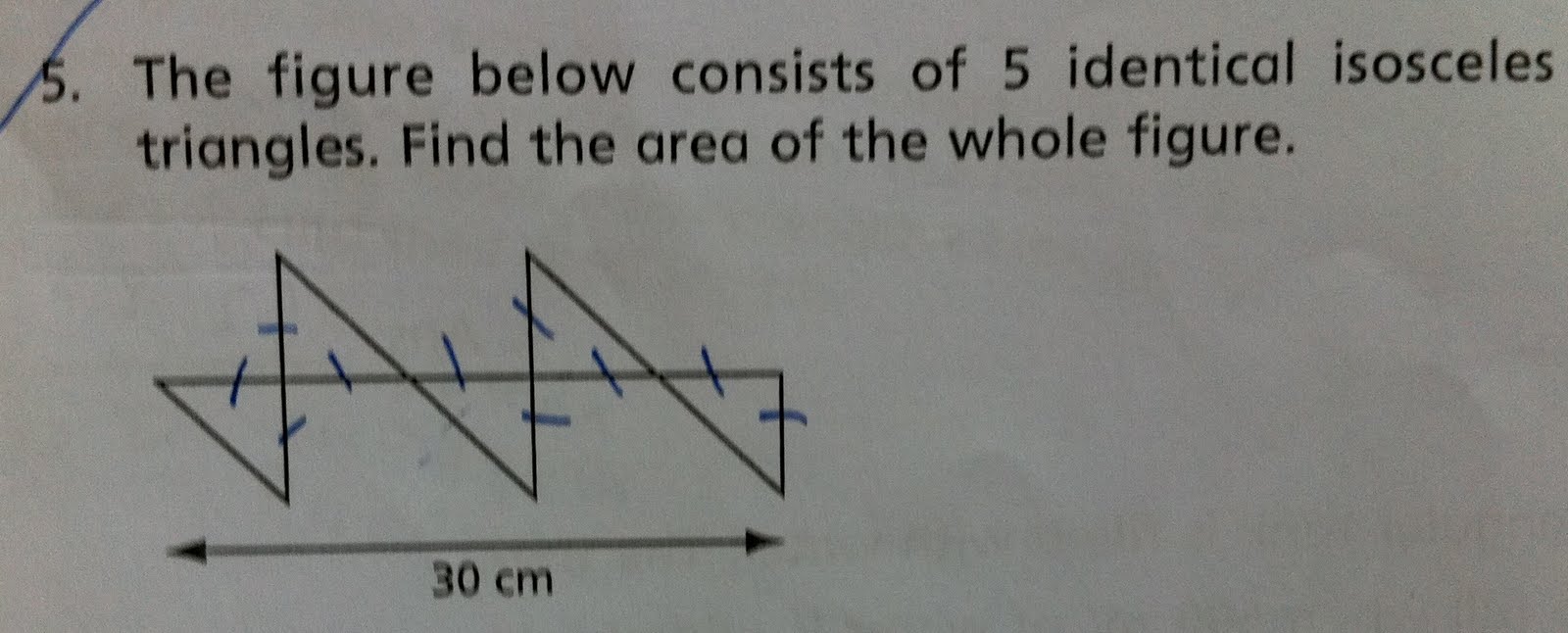
P5 area of triangles application


My solution:

1 base --> 30 cm  / 5  =  6 cm
Area of 1 triangle --> 1/2  x 6 x 6 = 18 (cm2)
Area of whole figure --> 18 x 5 = 90 (cm2)

P5 fraction and percentage


My solution:

75% = 3/4 = 6/8

6/8 - 5/8 = 1/8

1/8 --> 500 mil

Capacity (1 whole) --> 500 mil  x 8 = 4000 mil = 4 litres

P5 ordering proportion ( fraction, decimal, percentage )


My solution:

The numbers in decimal respectively:
       0.452,    0.429,    0.400,    0.425

"Descending order" means "arranged from big to small"
Hence, the required answer:
0.452,  3/7,  0.425,  40%

P5 time


My solution:

100m --> 1.8 min
500m --> 1.8 min x 5 = 9 min
9 min  before 9.30 am  is 9.21 am

Saturday, September 24, 2011

P5 percentage


[ taken from: NMOS 2010 Olympiad Competition by NUSH ( Preliminary Round) ]

My solution:
. _______ ? ________
. / \
From Betty |--------------------|
To Cathy:
Case 1: $140 10% disc
. / \ / \
. |--------------------|----|-------|
Case 2: $200 5% disc
. / \ / \
. |--------------------|--------|---|
10% - 5% = 5%
$200 - $140 = $60
5% --> $60
100% --> $60 x 100 / 5 = $1200
Cost of camera from Betty --> $1200 - $200 - $60 = $940

P5 average and percentage

[ taken from: NMOS 2010 Olympiad Competition by NUSH ( Preliminary Round ) ]

My solution:

Total of 5 tests --> 89 x 5 = 445
Eng + Chi + Art --> 92 + 95 + 86 = 273
Math + Sci --> 445 - 273 = 172

The statement "Science score was 15% higher than his Math score" means...
... If Math score is 100 units, Science score would be 115 units.

Math and Sci (in terms of units) --> 100 + 115 = 215 (units)
215 units --> 172 marks
100 units (Math score) --> 172 / 215 x 100 = 80 (marks) 

Monday, September 19, 2011

Thursday, August 11, 2011

P6 Percentage question

There are more pupils in School A than School B. 30% of the pupils in School A is 45 more than 40% of the pupils in School B. If 10% of the pupils in School A leaves to join School B, there will be 200 more pupils in School A than School B.
(a) How many pupils are there in School B?
(b) How many percent less pupils are there in School B than School A?
Leave yr answer as fraction in the simplest form.

Saturday, July 23, 2011

P5 Volume

P5 Ratio

P5 fraction and money

P5 area & perimeter

P6 Decimals ( systematic increment)


Timothy wants to buy a skateboard. It costs $17.25. Every week he saves $1.20 more than the week before. After saving for a number of weeks, he bought the skateboard.
 
(a) What is the least number of weeks he needs to save enough to buy the skateboard?
 
(b) How much of his savings did he have left after buying the skateboard?
 
Do we assume that Timothy started saving $1.20 on the first week? The question did not state how much Timothy saved on the first week.
 
(fr: JH, 23/7/11)

Wednesday, May 11, 2011

P5 Whole numbers

Sandra had twice as many apples as oranges at first. She removed 4 apples and 3 oranges each time. In the end, there were 18 apples and 1 orange left. How many fruits did Sandra have at first?

My solution:

Monday, May 2, 2011

P6 fraction, mutual transfer

P5 Fraction, (2 variable prob)

J had 933 chairs n tables at first. After he sold 2/5 of the tables n 5/8 of the chairs, he had 459 tables n chairs left. How many tables did he sell?
(ans: 194?)